Whether you are launching your very first blog, scaling a booming eCommerce store, or migrating a legacy enterprise application to a modern infrastructure — choosing the right type of web hosting is the single most consequential decision you will make for your online presence. The wrong choice can cripple your site’s speed, security, and scalability. The right one? It accelerates growth, keeps your visitors happy, and puts money back in your pocket.
In this definitive guide, we break down every type of web hosting available in 2025, compare their performance, pricing, and ideal use cases — so you can make a confident, informed purchase decision today. We have also included exclusive deals from the best hosting providers to help you get started without overspending.
1. What Is Web Hosting and Why Does It Matter?
Web hosting is the foundation of every website on the internet. In simple terms, a web hosting provider stores your website’s files — HTML, CSS, images, databases — on a powerful server and makes them accessible to anyone who types your domain into a browser, 24 hours a day, 7 days a week.
The quality of your hosting directly determines your website’s loading speed, uptime reliability, security posture, and SEO ranking. Google’s Core Web Vitals explicitly factor in page speed, making hosting performance a direct ranking signal. A site hosted on a sluggish, over-shared server will lose visitors to faster competitors — and lose positions on search engine results pages.
Choosing the best web hosting plan means matching your website’s specific needs — traffic volume, technical complexity, budget, and growth trajectory — to the right hosting environment.
2. Shared Hosting — The Beginner’s Gateway to the Web
Beginner-Friendly Low Cost Limited Resources
What Is Shared Hosting?
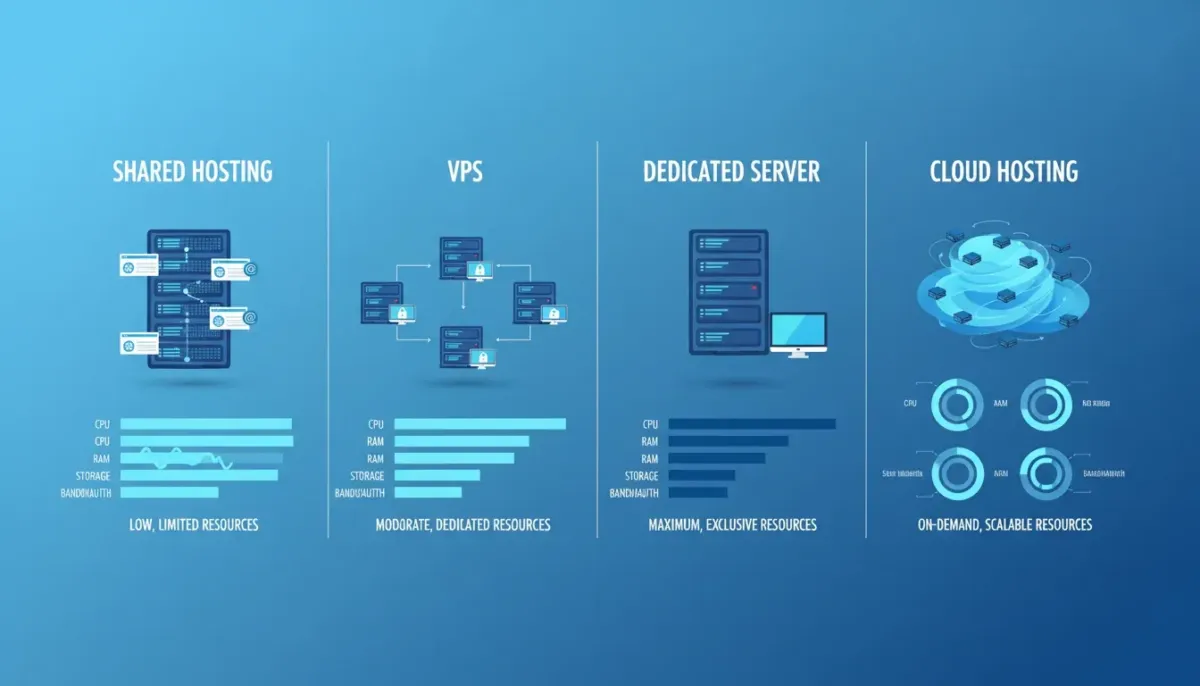
Shared hosting is the most widely used and budget-friendly type of web hosting. In this model, hundreds or even thousands of websites share the same physical server and its resources — including CPU power, RAM, bandwidth, and disk storage.
Think of shared hosting like renting a room in a house. You share the kitchen and bathrooms with other tenants, which keeps costs low, but peak-hour usage by your neighbors can slow things down for everyone.
Who Should Use Shared Hosting?
Shared hosting is ideal for personal blogs, small business websites, portfolio sites, and beginners who are just getting started online. If your site receives fewer than 10,000–20,000 monthly visitors and doesn’t require heavy server customization, shared hosting delivers excellent value.
Best For: New bloggers, small business landing pages, hobby sites, students learning web development.
3. VPS Hosting — The Power User’s Strategic Upgrade
Mid-Tier Dedicated Resources Developer Favorite
What Is VPS Hosting?
Virtual Private Server (VPS) hosting uses virtualization technology to partition one physical server into multiple isolated virtual machines. Each VPS operates independently with its own dedicated allocation of RAM, CPU cores, storage, and bandwidth — even though the underlying hardware is shared.
VPS hosting is the sweet spot between shared hosting’s affordability and dedicated hosting’s raw power. It gives you root access, full server customization, and consistent performance at a fraction of the cost of a dedicated machine.
Managed vs. Unmanaged VPS
Managed VPS: The hosting provider handles server updates, security patches, and monitoring. Ideal for non-technical users who need performance without the sysadmin burden.
Unmanaged VPS: You have full root access and manage the server environment yourself. Favored by experienced developers who want complete control.
Best For: Growing websites, eCommerce stores, web developers, agencies managing multiple client sites, SaaS applications.
4. Dedicated Server Hosting — Total Performance, Zero Compromise
Enterprise Grade Maximum Power Full Control
What Is Dedicated Server Hosting?
A dedicated server means exactly what it sounds like — an entire physical server is leased exclusively to you. No other website or client shares your hardware. Every single CPU core, gigabyte of RAM, and terabyte of storage is 100% yours.
This is the premium tier of traditional hosting, engineered for high-traffic websites, mission-critical applications, and organizations that demand maximum performance, security, and compliance. Dedicated servers are commonly used by large media publishers, financial platforms, online gaming servers, and enterprise portals.
Best For: Large enterprises, high-traffic media sites, gaming servers, financial services, healthcare applications requiring strict data isolation.
5. Cloud Hosting — The Modern Standard for Scalability
Highly Scalable High Availability Pay-As-You-Go
What Is Cloud Hosting?
Cloud hosting distributes your website across a vast network of interconnected virtual servers — the “cloud.” Unlike traditional hosting where your site lives on one physical machine, cloud hosting pulls resources dynamically from multiple servers simultaneously.
This architecture makes cloud hosting virtually immune to single-point failures. If one server goes down, another instantly takes over. Resources — bandwidth, CPU, RAM — can be scaled up or down in real time based on your traffic demands, and you typically pay only for what you consume.
Best For: Startups expecting rapid growth, eCommerce sites with seasonal traffic spikes, SaaS platforms, content-heavy websites, any business prioritizing uptime and global reach.
6. Managed WordPress Hosting — Purpose-Built for WordPress Excellence
WordPress Optimized Fully Managed SEO Performance Boost
What Is Managed WordPress Hosting?
Managed WordPress hosting is a specialized hosting environment fine-tuned exclusively for WordPress websites. The hosting provider handles all technical aspects of running WordPress — automatic core updates, daily backups, security hardening, performance caching, and malware scanning — freeing you to focus entirely on your content and business growth.
These environments are architecturally optimized at the server level for WordPress performance: server-side caching, PHP version optimization, CDN integration, and one-click staging environments are standard inclusions. The result is a dramatically faster, more secure WordPress experience compared to generic shared hosting.
Best For: Bloggers, content creators, news publishers, WooCommerce store owners, businesses running their entire digital presence on WordPress.
7. Reseller Hosting — Turn Hosting Into a Revenue Stream
Reseller hosting allows individuals or agencies to purchase hosting resources in bulk from a primary provider and then resell them to their own clients under a custom brand. You essentially become a hosting provider yourself, setting your own pricing tiers and managing multiple client accounts through a white-label control panel (typically WHMCS).
Reseller hosting is a popular revenue model for web designers, digital agencies, and IT consultants who already manage multiple client websites. Instead of directing clients to third-party hosting companies, you monetize the hosting relationship directly.
Best For: Web design agencies, freelance developers managing 10+ client websites, digital entrepreneurs looking to build a hosting business.
8. Colocation Hosting — Own the Hardware, Rent the Space
Colocation (colo) hosting is for organizations that want to own and operate their own physical server hardware but house it in a professional data center facility. You purchase and configure your own servers, then pay the colocation provider for physical rack space, reliable power supply, cooling infrastructure, and high-speed internet connectivity.
Colocation delivers the ultimate in hardware control and customization while benefiting from enterprise-grade data center infrastructure — redundant power, physical security, and direct fiber internet connections — without the cost of building your own facility.
Best For: Large enterprises with specialized hardware requirements, organizations with strict data sovereignty needs, businesses making long-term infrastructure investments.
9. How to Choose the Right Web Hosting Plan in 2025
With so many hosting types and hundreds of providers competing for your business, the selection process can feel overwhelming. Narrow your choice using these five decisive criteria:
Traffic Volume: Under 10K monthly visitors → Shared Hosting. 10K–100K → VPS or Cloud. 100K+ → Dedicated or Cloud.
Technical Skill Level: Beginners should choose managed or shared hosting. Developers and sysadmins can leverage unmanaged VPS or dedicated servers for greater control and cost efficiency.
Budget: Shared hosting starts under $2/month; managed WordPress and VPS range from $25–$100/month; dedicated servers begin at $100+/month.
CMS Platform: Running WordPress? Managed WordPress hosting is purpose-built for maximum compatibility, speed, and security. Using Magento, Drupal, or a custom stack? VPS or cloud gives you the freedom to configure your environment precisely.
Growth Expectations: If you anticipate fast user growth or unpredictable traffic spikes, cloud hosting’s elastic scalability is your safest long-term investment.
10. Best Hosting Providers & Exclusive Deals for 2025
Best Overall Shared Hosting
Bluehost — Officially recommended by WordPress.org. Plans start at $1.99/month with a free domain, free SSL, and one-click WordPress installation. Ideal for beginners launching their first website. 99.9% Uptime Guarantee Free Domain for 1 Year 24/7 Expert Support
Best Performance VPS Hosting
Hostinger VPS — Delivers exceptional NVMe SSD performance at competitive price points. Plans start at $4.99/month with full root access, a user-friendly hPanel, and guaranteed resources. Outstanding value for developers and growing businesses. NVMe SSD Storage Full Root Access AI-Assisted Setup
Best Cloud Hosting
Cloudways — A managed cloud hosting platform that lets you deploy on top cloud infrastructure providers (DigitalOcean, Linode, AWS, Google Cloud, Vultr) through a single, beautifully designed dashboard. No long-term contracts. Pay-as-you-go pricing starting from $11/month. Multi-Cloud Provider Managed Platform Free Trial Available
Best Managed WordPress Hosting
WP Engine — The industry benchmark for premium managed WordPress hosting. Blazing-fast page loads powered by a global CDN, automated daily backups, staging environments, and a WordPress-exclusive support team available around the clock. Plans start at $25/month. Genesis Framework Included Global CDN Daily Backups
Best Dedicated Server Hosting
Liquid Web — Renowned for its “Most Helpful Humans in Hosting” support philosophy. Fully managed dedicated servers with 100% network uptime SLA, enterprise-grade hardware, and proactive monitoring. Trusted by over 45,000 brands worldwide. 100% Network Uptime SLA Fully Managed HIPAA/PCI Compliant
11. Frequently Asked Questions About Web Hosting Types
Q: What is the cheapest type of web hosting available?
Shared hosting is by far the most affordable option, from providers like Bluehost and Hostinger. These plans are ideal for new websites with moderate traffic requirements.
Q: Is cloud hosting better than VPS hosting?
It depends on your priorities. Cloud hosting offers superior scalability and uptime redundancy, making it better for unpredictable traffic. VPS hosting provides more consistent, dedicated resources at a lower monthly cost for steady workloads. For most growing businesses, cloud hosting is the more future-proof investment.
Q: Which type of hosting is best for WordPress?
Managed WordPress hosting is specifically engineered for WordPress performance and is the strongest recommendation for serious WordPress site owners. However, shared hosting is a viable starting point for new blogs, and VPS hosting suits more technically advanced WordPress users who want greater server control.
Q: What hosting type is best for an eCommerce store?
For eCommerce websites, we recommend either managed WordPress hosting (with WooCommerce) or a VPS/cloud hosting plan. eCommerce demands consistent speed, security, PCI compliance, and the ability to handle traffic surges during sales events — capabilities that shared hosting cannot reliably deliver.
Q: Does hosting type affect Google SEO rankings?
Absolutely. Google’s ranking algorithm explicitly evaluates page speed and Core Web Vitals, both of which are heavily influenced by your hosting environment. Premium hosting — particularly managed WordPress, VPS, or cloud — provides the server response times required to achieve superior SEO rankings compared to over-crowded shared servers.
Q: What is the difference between managed and unmanaged hosting?
With managed hosting, the provider handles server maintenance, security updates, backups, and technical configurations on your behalf. With unmanaged hosting, you are responsible for all server administration tasks. Managed plans cost more but save significant time and reduce technical risk, especially for non-developers.